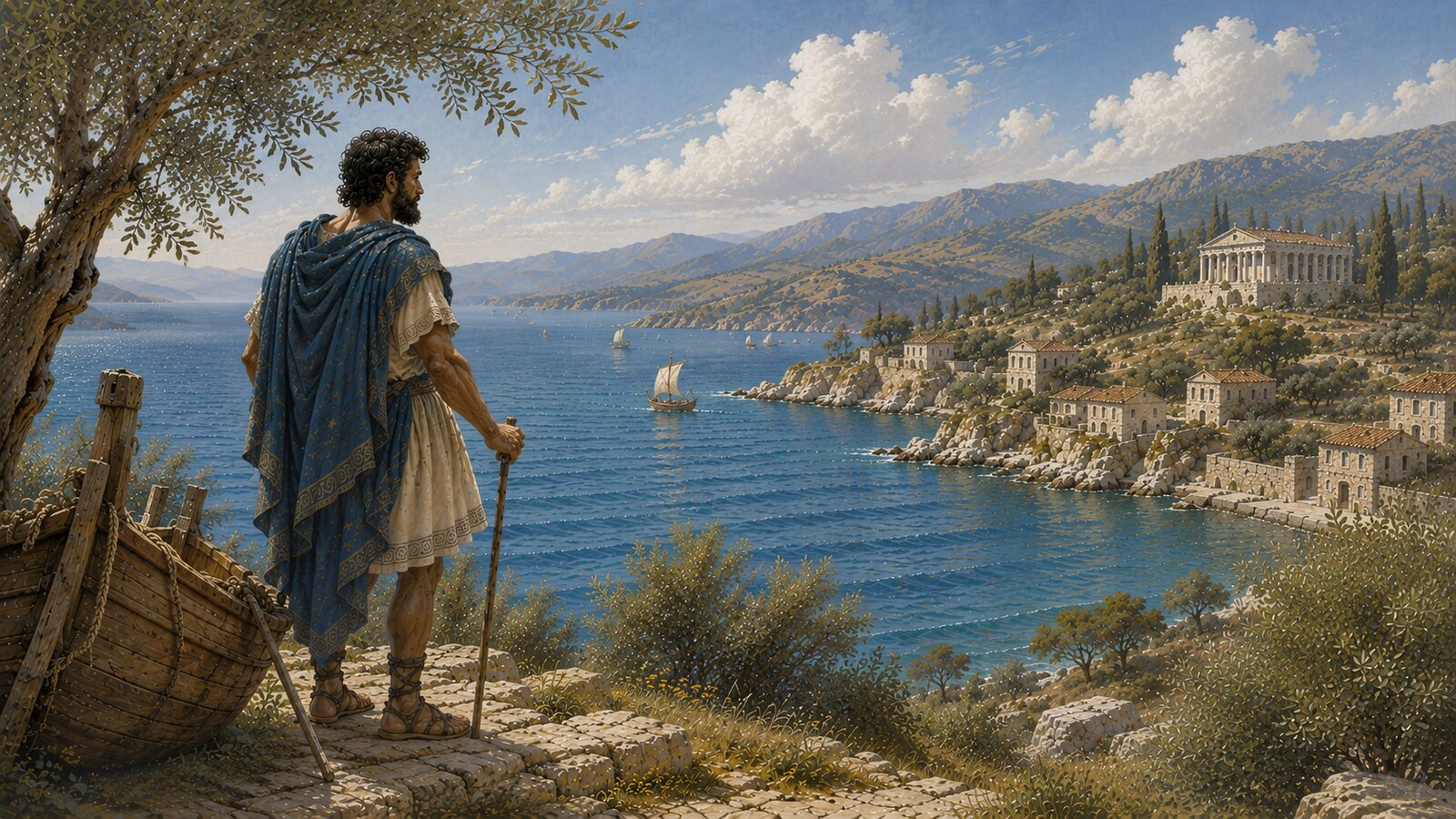
Editor’s Note. This is an abridged version of Ian Johnston’s “Lecture on the Odyssey,” originally prepared in 1996 and revised in August 2004. Johnston placed the original lecture in the public domain. This version preserves Johnston’s wording in the passages retained while removing some course-specific material, historical detail, repetition, and extended comparisons with the Book of Genesis.
Introduction
In any discussion of the Odyssey, we might begin by acknowledging that this is an extraordinarily influential book, not simply for the ancient Greeks but throughout Western culture. It has for centuries been one of the most perennially popular classics, both for general readers and for aspiring artists in all sorts of genres from lyric poetry to the visual arts.
It has influenced the literature of the entire world and continues to do so to a remarkable extent—both in the high culture and in popular culture (from James Joyce’s Ulysses to television’s Xena the Warrior Princess or Hercules). In this lecture today, I hope to offer a few possible reasons for that extraordinary and continuing popularity and influence.
A Brief Historical Note: Homer
Homer is the name of the person traditionally credited with the authorship of two major epic poems, the Iliad and the Odyssey, each consisting of twenty-four book of hexameter verse in an ancient Greek dialect. The first deals with some very famous incidents in the tenth year of the Trojan War, with special attention to the greatest warrior in the Greek forces, Achilles, and the second deals with the ten-year return from that war of a prominent leader of the Greek force, Odysseus, King of Ithaca.
There has been a very long debate about the identity of Homer. From the material in the poems, we estimate that the works which bear his name were composed in the middle of the eighth century BC, around 750 BC. The stories that he tells are about a time well before that, probably around 1100 BC. Particular details of Homer's life, his identity, and his times are all totally obscure, except what we can glean from the poems themselves or from archaeological clues. There are virtually no other reliable sources of information.
It seems clear that these poems were composed before the introduction of writing into Greece. Hence, Homer, whoever he was, composed the works orally, committed them to memory, and recited them on demand, perhaps with a certain amount of improvisation to take into account the particular preferences of his audience.
For the past two hundred years at least, since the rise of modern Homer scholarship, there has been considerable argument whether this traditional account of Homer is correct. Some have held that no single poet could have written two such different poems as the Iliad and the Odyssey. Others have claimed that the term Homer refers to a family of bards entrusted with memorizing, embellishing, performing, and passing on these ancient poems over a period of many centuries. Still others have maintained that the name Homer refers to the person or persons who put together a number of different traditional poems to create these two epics. Since there is no strong independent evidence to support or refute any of these conflicting ideas, no consensus has emerged about the author's identity.
What is indisputable is that these two poems acquired in ancient Greece, and especially in Athens, an extraordinary authority, forming the closest thing to a sacred text which the Greeks shared. Homer's poetry became not simply a treasury of ancient history but also a vital source of moral instruction, and Achilles and Odysseus, the two heroes, become the great role models in traditional Greek thinking about how one should live one's life.
The Odyssey as an Epic Poem
The Odyssey and the Iliad are commonly called epic poems, a term derived from one of the Greek words for poetry, and this phrase is applied to a certain style of writing based, in large part, on the models and criteria established by Homer's work, an extremely important form in the history of Western literature, since composing an epic work was for a long time considered the highest achievement a writer could attain.
An epic poem, following the example of Homer, is a long narrative poem organized in a series of books (usually twelve or twenty four). The story characteristically begins in the middle of the action and fills in the details of past events in various ways as the narrative proceeds. What gives the long work its epic character, however, is its scope. These works present the reader with what amounts to a comprehensive vision of experience at a particular cultural moment. So the poem is not merely a long story about particular people in particular places; it is also a detailed cultural and spiritual map, delineating an entire belief system, the very basis of a civilization.
The epic character of the Odyssey is readily apparent. The poem takes us on a long journey to various centres of civilization, explores many different aspects of the wilderness, subjects a civilization's values, as these manifest themselves in the hero and heroine and the minor characters, to a series of tests, and illuminates for us the relationship between the gods and mortals, the present and the past, visions of this life and the next. It thus offers us a valuable and detailed picture of a particular culture's sense of what it means to be a civilized, moral, and excellent human being.
Some Comments on the Structure and Style of the Odyssey
Before getting to what I really want to discuss in detail—that is the vision of life in the Odyssey and the character of the hero, I must first, however cursorily, acknowledge one great source of the pleasure we derive from reading this poem: its structure, that is, the way in which the narrative is organized.
One of the first things that strikes many readers about the Odyssey is that we are clearly here in the presence of a very sophisticated story teller who is manipulating certain conventions of fiction in remarkable ways. For instance the narrative line of the Odyssey lays down two stories initially—the first one focusing on Telemachus and Penelope and events in Ithaca, and the second, which does not begin until Book V, focusing on the hero Odysseus. And when we begin to follow Odysseus's adventures, we have to keep close track of where we are, because the narrative uses a number of flashbacks, interruptions, and time shifts.
The two narrative lines come together when the father and son are reunited in Book XVI, and the two stories march together to their common conclusion, although even here there are repeated shifts from one part of the action to another and back again.
When we think of the Odyssey, we tend to concentrate much of our focus on Odysseus himself, and certainly most of the really famous incidents from this poem concern the adventures of the main hero. But if we read the poem carefully, we should note just how much emphasis the structure gives to Odysseus's family, especially to his wife and son. In a way, the narrative emphasis in the structure puts pressure on us to see in this story more than just the memorable events in the hero's life, reminding us that this story is also about a family and about how each of the principal members of that family plays an important role in the successful reunion and the restoration of a traditional ruling household.
Reinforcing this sense of a spatial emphasis is the distinctive style in which Homer tells his story. There is not time to go into this in detail, but I would like briefly to mention a very famous essay on this subject which I recommend highly, the essay "Odysseus’ Scar," the first chapter of Erich Auerbach’s remarkable book Mimesis: The Representation of Reality in Western Literature.
In this essay Auerbach discusses how Homeric story telling is leisurely and digressive, with everything fully illuminated in long descriptions of past events or beautiful places and leisurely conversations at length. There is no attempt to move quickly or to generate suspense. What matters here is external description rather than psychological depth, historical development, or narrative suspense. The style celebrates the rich and fully detailed spatial surfaces of life. One of the great pleasures of reading the Odyssey comes from this vividly interesting and yet apparently relaxed way in which the story is told.
The Vision of Life
Now, however, I would like to direct our attention onto the world we confront in this epic. What are we to make of it? A good place to start might be to ask the following question: What is about this ancient poem, composed more than 2500 years ago, that makes it such a lasting pleasure for readers, more immediately accessible to modern students, for example, than almost any other ancient text?
What I'd like to suggest, first of all, is that this poem is a wonderful celebration of things which human beings have always particularly cherished, even today in these very different times. When we read this work we find in its value system and vision of the world a confirmation of many things we would most like to celebrate as well.
And what are those things? Well, briefly put, they are the peaceful joys available in a world in which the main concerns of human beings are family, friends, works of art, good food, conversation, hospitality, leisure, entertainment—a life dedicated to human warmth, security, and pleasure in good company, especially in our own families and communities. Again and again in the Odyssey we witness scenes where these qualities are celebrated and endorsed.
The world may often be dangerous, the main characters may be growing older, and we are certainly conscious of evil lurking here and there; nevertheless life is full of joys, and it is entirely right and proper that we should find in them the guiding purposes of life.
The idea that hearth and home can and should be the centres of our lives, that we find our proper justification in the everyday qualities that an appropriately respected and protected home life provides—this idea is still, I would argue, one of our most cherished visions.
Think for a moment just how much of this poem is taken up with the pleasures of domestic hospitality—the eating, drinking, story telling, music, intimate conversations, warm beds, perfumed baths, dancing, beautiful architecture and silverware—all that "cozy eroticism" that transforms everyday events into something joyful and worthwhile. Coleridge called the Odyssey that "eating poem," and one sees what he means—at every stage people are sitting down together and stuffing themselves, taking part in what must be the oldest and most frequent communal social ritual, a shared meal at which anonymous guests who show up unexpectedly at the door are welcome.
Moreover, let us consider for a moment the most obvious organizing principle of this story—it focuses on the return home by the head of the family and the continuing attempts of those left behind to sustain the home until such a return. Throughout the story the preservation and the strengthening of the traditional home is the overriding value before which others must give way.
We learn early in the poem from the gods themselves that this universe has a single coherent and binding moral principle, that the home must be respected. There are many references throughout the poem to the famous story of Agamemnon, the leader of the Greek expedition against Troy, who was murdered by his wife, Clytaemnestra, and her lover, Aegisthus, and of his son, Orestes, who avenged the murder by killing Aegisthus.
In other words, central to the vision of the Odyssey is the upholding of the major moral principle of the universe: the value of the home. This is, if you like, the ethical norm established in the poem both in the commandments of the gods and the actions of the principal characters. And Homer in the early books makes sure we see just what that home life really means, in the courts of Nestor and Menelaus.
This particular point comes out here and throughout the poem on the special emphasis given to women. In marked contrast to the Iliad, the Odyssey gives special value to those women who successfully nurture their homes: Helen, Arete, and, above all, Penelope. These women concern themselves a great deal with the proper forms of hospitality, with making sure everyone is comfortable, getting enough to eat, easing their daily cares in the communal rituals of the home.
And it is also clear that the home is still there for Odysseus to come back to because of the intelligence, courage, and love of Penelope. It is thus fitting that the final test Odysseus must undergo is controlled by his wife.
There is, of course, another group of women—the temptresses, the wild women, those who lure the adventurer into the wilderness so that he will never return: the Sirens, Circe, Calypso. These women are divine and surpassingly beautiful, with magical powers and eternal life. They surely tempt Odysseus. But they are not his home. That for Odysseus is defined by Penelope—and he prefers human life in a civilized home to eternal life on an enchanted island.
The Gods as Visual Manifestations of the Divine
The mention of the gods in connection with the overriding moral principle I have referred to brings us to what Homer is particularly famous for: his creation of the gods and goddesses. No one who reads the Odyssey can fail to appreciate that these divinities are important. But we might well wonder how we are supposed to deal with them. Just what do they represent?
For a long time, a number of interpreters neutralized any challenge this vision of the divine might have for us by insisting that these gods and goddesses were not intended seriously, that they are simply a delightful poetic creation and have little to do with serious religious belief. That view of the matter is surely inadequate. The characters in the poem certainly take their gods and goddesses very seriously: they are the central issue in their beliefs about the world. We know that the classical Greeks took their gods very seriously and organized their religious life around worshipping them. And Homer's depiction of the gods was a vitally important shaping influence in developing that religion.
Homer's divine universe is plural and made up of innumerable creatures who are recognizably like human beings. In many ways they are indistinguishable from human beings except for three things: their immortality, their power, and their beauty. The world of the Odyssey, like that of the Iliad, conceives of these gods in very sharp relief, in very particular visual detail.
The world of the Odyssey is one which thus sees the ruling powers of the world, the forces which control everything which goes on in nature and human life, as huge beautiful humanlike beings. These divinities, we should note, exist everywhere in nature. Poseidon, for example, is god of the sea, and the sea is the place where he resides. But in a complex sense Poseidon, along with a host of minor deities, also is the sea.
In the same way, a eagle flying up in the sky may be a messenger from Zeus, an omen of Zeus, or even Zeus himself. The entire world of nature is permeated by divinities, major and minor, and one cannot easily draw a line between nature and the divinities which shape and control it.
In the Odyssey much of nature is beautiful, mysterious, and fecund—food grows on Polyphemus' island without any cultivation, and Calypso's place is like a natural paradise. But the wilderness is also dangerous. The vision here is ambiguous—the wilderness is magical, divine, a source of inspiration, seductive song, even health; on the other hand, it is dangerous, a place where people get killed or transformed or go mad or lose their will to seek out civilization.
The Odyssey also presents these divine personalities as a huge interconnected family—ranging from the senior and most important members, the Olympian deities, down to innumerable nymphs and minor deities. What this does is make the universe and everything that happens in it emotionally intelligible as effects of divine actions, since we all have some familiarity with families and their idiosyncrasies.
It also means that a great deal of the faith in the gods in the Odyssey is something we might call a belief in the irrational feelings of divine powers. These Greeks do not demand or always expect a particular god to behave in a rational or moral manner.
But the gods of the Odyssey are not entirely irrational. In the Odyssey, as I have mentioned, they all acknowledge the principle of the sanctity of the home. Thus, there is at least one basic cosmic moral operating principle in this world.
The most significant of these direct interventions of the divine into human affairs in the Odyssey occurs at the very end of the poem, where Athena (in the guise of Mentor) succeeds in ending the rapidly escalating warfare which threatens the entire society. To some readers, this looks like a rather unconvincing and quick way of resolving a serious conflict. Perhaps. But it also provides us with a final emphatic indication that, so far as the gods are concerned, the important priority in the human community must be preserving the home, rather than engaging in repetitive and aggressive acts of blood revenge which threaten the survival of Ithaca.
Odyssey: The Character of the Hero
To establish the point more clearly about this being a world governed by a moral principle endorsing the traditional home and family and community, I want to consider now the adventures of Odysseus chronologically, that is, in the order in which they occur (not in the order in which they are told). I want offer the suggestion that one really important issue in this book is the importance of learning how to value one’s home, particularly with respect to other priorities.
When we first meet Odysseus in Book V, on the island of Calypso, he is yearning for home—something he prefers to immortality and life with a beautiful goddess in a wonderful natural paradise. The initial thing we learn about him is that his major motivation in life is an overwhelming desire to get home, back to a traditional human life on Ithaca. But this point, of course, is late in his adventures.
When we consider the story of Odysseus in the chronological sequence of events, we can see that he was not always like this in his attitude to life. And I would suggest for your consideration an important theme in this story of Odysseus's adventures—namely, that his journey is, in large part, a process which educates him into the values of his home and his life as a peaceful head of a family and community. In a sense, the story insists that he has to be prepared for a suitable return.
At the start of his adventures Odysseus is a warrior king, committed to the world of the Iliad, a world in which the predominant value in life is military fame acquired in battle. That is the reason the warriors, including Odysseus, left their homes and went to Troy all those years before and are prepared to die for glory rather than leave the battle and go back.
And when he first leaves Troy for home, Odysseus acts very much like a traditional warrior, setting out with boatloads of warrior followers to raid neighbouring cities for booty and fame. Going home may be important, but more important is to make sure that one's warrior reputation and wealth are augmented in the process.
And for the next events in the series we follow Odysseus very much as the self-assertive, aggressive, always curious warrior-adventurer, taking himself and his men through a series of events in which he has to confront the unknown: the Lotus Eaters, the Cyclops, the King of the Winds, the Laestrygonians, Circe, the Underworld, the Sirens, Scylla and Charybdis, the Islands of the Sun.
You might have noticed how as these adventures progress Odysseus loses more and more of his men, more and more of his ships, so that those things which make up his warrior identity are inexorably stripped away, until he is tossed up on Calypso's island. From there he goes to Phaeacia, where he arrives naked, alone, and without any sign of his status or warrior fame. He is anonymous—he has lost the identity he had at the start of his adventures.
In Phaeacia, he begins to put his identity back together again. But he does it in a curious way. The memory of the Trojan War, the subject matter of the dinner entertainment, fills him with sadness for a life that is over. While he has fond memories of it, he acknowledges that it is behind him now. He declares who he is and begins to reconstruct himself in the Phaeacian games, part of the domestic celebrations, part of the most important social virtue, hospitality.
Back in Ithaca, he is no longer a proud warrior leader. He is anonymous, disguised, and alone. Bit by bit he reconstructs his social identity—revealing himself to his son, to the nurse, to the swineherd and goat-keeper, to his wife, and finally to his father.
In the process of re-establishing himself as a community leader, rather than as a warrior leader, he has to pass a number of tests—tests of endurance, strength, courage, wit, and so on. In this testing, Odysseus has to disguise who he is and use something no noble warrior would ever resort to, duplicity and deceit.
First and foremost he displays an ability to endure, to do whatever is required to get through a particular situation. He is certainly not driven by a death-before-dishonour ethic which has no room for dissimulation and which scorns mere survival as an important priority.
Odysseus has an incurable capacity for getting himself into difficult situations, generally because he has an insatiable desire for self-assertion, for spreading throughout the world the knowledge of himself and his reputation, and these situations call from him a wide range of resources: forethought, courage, imaginative planning, deceit, invention, an ability to manipulate language to his advantage.
The second group of difficulties are the temptations to give up—the recurring desire to stop and surrender to the seductive allure of the Lotus Eaters, the offers of Circe or Calypso, the song of the Sirens, the pleasures of Nausicaa. To survive these temptations, Odysseus has to discover and hang onto his desire to return home.
What I'd like to suggest here is that in the development of Odysseus's character, this poem celebrates a certain quality of human experience: our ability to survive and to endure in order to get back home to the centre of the domestic community and to do so in such a way that we demonstrate and assert our own excellence. And this necessarily involves exploring a view of heroism significant different from the warrior ethic of Homer's earlier epic poem.
If you are still with me, let us consider for a moment what I take it we all recognize as a decisive moment in the poem, the visit to the underworld, in Book XI. At this point, Odysseus confronts his old way of life and bids farewell to it, as he meets the great heroes from the Iliad, those people who defined the Greek warrior ethic, Agamemnon, the leader of expedition, and Achilles, the greatest warrior of them all.
Death itself offers no reward commensurate to the loss of life on earth, not even for the greatest warrior of them all, the one who achieved the greatest fame.
To put this speech into the mouth of the greatest example of the traditional warrior is to underline in the most dramatic way possible the difference between this poem and its Homeric predecessor, the Iliad, and to place a particular emphasis on the way in which this poem sees the justification of life in the joys that are possible rather than in an enduring fame based on one’s heroic conduct in battles away from home.
One feature of the poem which underscores this point is the way in which Odysseus repeatedly has to confront the memory of his earlier identity as a mighty and famous warrior, something of which he is obviously very proud and fond. Such reminders of his earlier life suggest that Odysseus does not undertake the transition consciously or quickly. It comes as an earned insight into what now truly matters in a different stage of his life.
It’s important to note, as I’ve already briefly mentioned, that while the Odyssey is establishing a set of living priorities different from that earlier poem, there is still an enormous emphasis on the characteristic we most commonly associate with the classical Greek vision of life, namely the importance of heroic self-assertion. For Odysseus, like Achilles in the Iliad, is always striving, not only to be the best, but also to make sure that his demonstrated excellence is publicly known and acknowledged.
Comedy
Before concluding my discussion of the Odyssey, I'd like to generalize a bit about this vision of life as I have described it. Because it is from this poem, among some others, that we derive our understanding of what we call comedy. This epic poem is one of the most important visions of life in our traditions, enshrining our most endurable and popular sense of what matters most in human experience.
When we use the term comedy to describe a work of literature, we are referring to at least two qualities of the work: its structure and the vision of life that structure offers and celebrates. The term comedy does not, strictly speaking, necessarily mean that the work is funny (although it often is).
In terms of structure, the term comedy refers most simply to way the conflict in a story is resolved. If we acknowledge that stories usually begin with a normal situation being upset, so that the central characters have to deal with a transformed reality, then the comic story will typically follow the adventures of a hero or heroine who seeks to regain an upset normality. In other words, he wants to go home again. The Odyssey provides the first great model of this vision.
Odysseus is displaced, his domestic normality is upset, and he wants to get home. But many things stand between him and home—external obstacles which threaten to destroy him and inner obstacles which threaten to so sap his endurance and his faith in the voyage home that he will give up.
The conflict in the story of Odysseus is essentially a linear series of obstacles which Odysseus must overcome. He does so by using to the full his wide range of qualities and by adapting who he is and what he does to fit the particular situation he faces. In the process of overcoming this series of obstacles, he learns or he becomes transformed in some way, so that when the home is restored we have back again a lost normality or perhaps an even better reality, a transformed normality.
The Odyssey is our first great fiction celebrating this structure and this vision. Its decisive influence on western literature and art derives, in large part, from the fact that we find this vision very congenial. We may not believe in the same gods and goddesses, but, like Odysseus, many of us see in a story that celebrates the restoration of community and the home as the highest value in civilization—in the traditional comic vision—something very dear to our imaginations.
And thus the fundamental comic structure and comic vision have enjoyed and continue to enjoy a vital life in our culture. That may be the main reason why, as we read this book for the first time, it seems, in spite of the significant differences between its vision of experience and our own beliefs, so familiar, so agreeable, so immediately accessible to us.
A Postscript
These necessarily rather cursory remarks have said little about the final book of the Odyssey, where we return to the underworld and meet again some of the major figures from the Iliad. This section has in the past invited a good deal of commentary about its appropriateness in this narrative. Without going into that in detail, I tend to see this final book as, in a sense, a conclusion to both great epics, with a nod in the direction of the idea that saving the home and the community might just be a higher ideal than continuing the warrior life in a major civil war.
The narrative of the Odyssey also leaves somewhat up in the air the further travels of Odysseus. Teiresias insists he must continue traveling, this time far from the sea, and sacrifice to Poseidon in a country where no one has ever seen an oar. And Teiresias also prophecies a peaceful death for Odysseus among his prosperous people. But these details, like the various legends about Odysseus' further travels, are ambiguous, so that we are not able at the end of this story to cling firmly to a "happy ever after" scenario, in which Odysseus and Penelope live to a ripe old age together in Ithaca. To the extent that the different reminders of what the hero still has in store add an ironic resonance to the story, we might want to suggest that the endorsement this poem gives to the life in the home is not completely robust. The home and the values associated with it are fragile, threatened by the need for restless voyaging to dangerous and distant places, an urge inspired and demanded by the gods.
Source Note
Ian Johnston, “Lecture on the Odyssey,” revised August 2004. Originally prepared as a lecture in 1996. Republished from Ian Johnston’s online writings. The original essay was released by the author into the public domain.