Skip to content

Classics

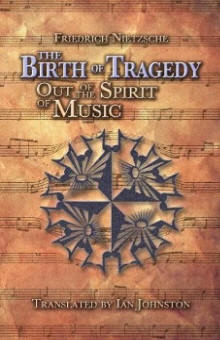
Birth of Tragedy

Out of the Spirit of Music

By Nietzshe, Friedrich

$13.95

Secure checkout · Free US shipping on orders over $50

Friedrich Nietzsche’s The Birth of Tragedy Out of the Spirit of Music, published in 1872, is not only the first major work of the most provocative voice in modern philosophy but also the most important study of Greek tragedy since Aristotle’s Poetics. In this remarkable essay Nietzsche announces his aggressive challenge to many of the most cherished philosophical assumptions of his own time, re-evaluates the development of classical Greek culture, and establishes aesthetic concepts which have had a decisive influence on modern discussions of art.

The Greeks, Nietzsche argues, were, in the period of their greatest achievements, thoroughly pessimistic but found in artistic creativity the only possible justification for existence. As a result of this development they produced Greek tragedy, the noblest affirmation of human life. The later development of Greek culture, particularly the influence of Socrates and Euripides, was not, as so many modern classicists have maintained, the high point of Greek achievement, but a significant decline, the onset of a sickness from which the world is still suffering (a significant symptom of which is our preoccupation with morality, especially Christian morality and our faith in scientific scholarship).
Central to Nietzsche’s discussion is his analysis of the development of Greek tragedy as the result of the inherent tension between and ultimate reconciliation of two conflicting artistic impulses, the Apollonian and the Dionysian (corresponding to the two sources of artistic inspiration, dreams and intoxication, the former giving rise to the plastic arts and the latter to ecstatic visions and music). Only with the appropriate synthesis of these two drives could the highest form of life be attained.

The Birth of Tragedy received a cool reception in Nietzsche’s day, especially from the academic community, but it has since become a central document in modern aesthetics and has led to a significant reappraisal of the nature of Classical Greek culture. The book also serves as an eloquent introduction to the disturbing challenges Nietzsche issued to modern thinking.

Ian Johnston’s new translation captures the energy, eloquence, and power of Nietzsche’s unique philosophical style in this extraordinary and influential work.
Category
Classics
ISBN (softcover)
978-1-935238-90-4
e-ISBN
978-1-935238-29-4
  • I would like to express my sincere thanks for your translation of Nietzsche\'s Genealogy of Morals. I am using it this semester in my Introduction to Philosophy course. I find it forceful and accurate, successfully capturing the spirit of the work, and my students find it stimulating and interesting to read. It is wonderful that you have made such a fine contribution to scholarship. (Rhode Island)

    ______


    I am not a student or academic. In my spare time, I read philosophy and am coming to grips with Nietzsche. I bought a translation of \"The Genealogy of Morality (/Morals)\" by Maudemarie Clark and Peter Swensen, but found your translation of infinitely more value. It is much easier to understand.

    ______

    I have read your translation of Nietzsche\'s Toward a Genealogy of Morals and consider it to be far clearer than Kaufmann\'s.

    ______

    Your translation is wonderfully done. I wrote a paper on \"On the Use...\" in a graduate seminar and the copy from our library was stilted and awkward. Everything else I had read by Nietzsche was wonderfully fluid and poetic. I couldn\'t believe that the version from our library was by the same author. Your translation captures Nietzsche\'s poetic element wonderfully, bravo!

  • I would like to express my sincere thanks for your translation of Nietzsche\\\'s Genealogy of Morals. I am using it this semester in my Introduction to Philosophy course. I find it forceful and accurate, successfully capturing the spirit of the work, and my students find it stimulating and interesting to read. It is wonderful that you have made such a fine contribution to scholarship. (Rhode Island)

    ______


    I am not a student or academic. In my spare time, I read philosophy and am coming to grips with Nietzsche. I bought a translation of \\\"The Genealogy of Morality (/Morals)\\\" by Maudemarie Clark and Peter Swensen, but found your translation of infinitely more value. It is much easier to understand.

    ______

    I have read your translation of Nietzsche\\\'s Toward a Genealogy of Morals and consider it to be far clearer than Kaufmann\\\'s.

    ______

    Your translation is wonderfully done. I wrote a paper on \\\"On the Use...\\\" in a graduate seminar and the copy from our library was stilted and awkward. Everything else I had read by Nietzsche was wonderfully fluid and poetic. I couldn\\\'t believe that the version from our library was by the same author. Your translation captures Nietzsche\\\'s poetic element wonderfully, bravo!

  • I would like to express my sincere thanks for your translation of Nietzsche\\\'s Genealogy of Morals. I am using it this semester in my Introduction to Philosophy course. I find it forceful and accurate, successfully capturing the spirit of the work, and my students find it stimulating and interesting to read. It is wonderful that you have made such a fine contribution to scholarship. (Rhode Island)

    ______


    I am not a student or academic. In my spare time, I read philosophy and am coming to grips with Nietzsche. I bought a translation of \\\"The Genealogy of Morality (/Morals)\\\" by Maudemarie Clark and Peter Swensen, but found your translation of infinitely more value. It is much easier to understand.

    ______

    I have read your translation of Nietzsche\\\'s Toward a Genealogy of Morals and consider it to be far clearer than Kaufmann\\\'s.

    ______

    Your translation is wonderfully done. I wrote a paper on \\\"On the Use...\\\" in a graduate seminar and the copy from our library was stilted and awkward. Everything else I had read by Nietzsche was wonderfully fluid and poetic. I couldn\\\'t believe that the version from our library was by the same author. Your translation captures Nietzsche\\\'s poetic element wonderfully, bravo!

  • I would like to express my sincere thanks for your translation of Nietzsche\\\\\\\'s Genealogy of Morals. I am using it this semester in my Introduction to Philosophy course. I find it forceful and accurate, successfully capturing the spirit of the work, and my students find it stimulating and interesting to read. It is wonderful that you have made such a fine contribution to scholarship. (Rhode Island)

    ______


    I am not a student or academic. In my spare time, I read philosophy and am coming to grips with Nietzsche. I bought a translation of \\\\\\\"The Genealogy of Morality (/Morals)\\\\\\\" by Maudemarie Clark and Peter Swensen, but found your translation of infinitely more value. It is much easier to understand.

    ______

    I have read your translation of Nietzsche\\\\\\\'s Toward a Genealogy of Morals and consider it to be far clearer than Kaufmann\\\\\\\'s.

    ______

    Your translation is wonderfully done. I wrote a paper on \\\\\\\"On the Use...\\\\\\\" in a graduate seminar and the copy from our library was stilted and awkward. Everything else I had read by Nietzsche was wonderfully fluid and poetic. I couldn\\\\\\\'t believe that the version from our library was by the same author. Your translation captures Nietzsche\\\\\\\'s poetic element wonderfully, bravo!

Also from Classics

You might also like

Birth of Tragedy

$13.95