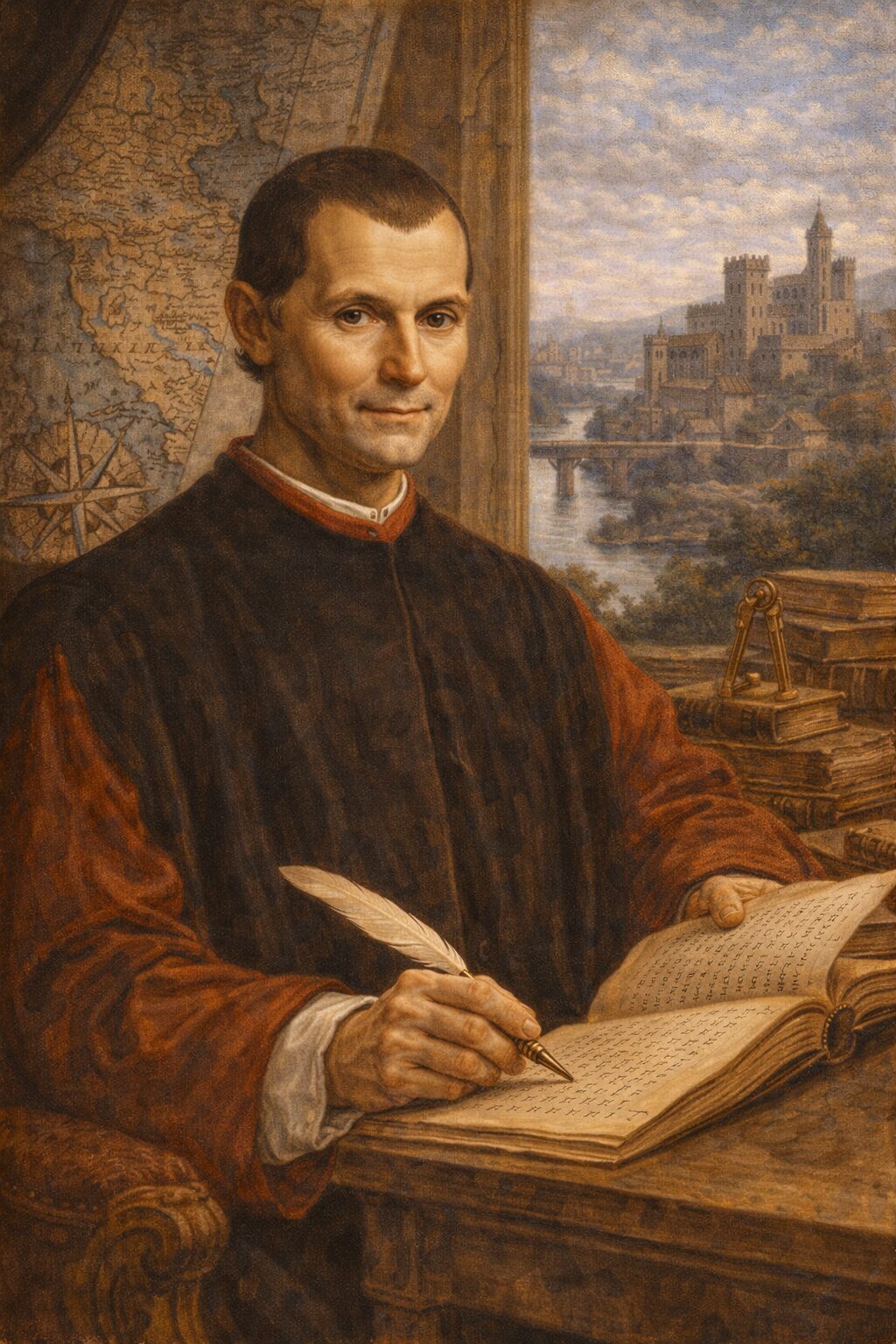
Niccolò Machiavelli is perhaps the most misunderstood historical character in European history. Considered – both in his own times and in ours – the personification of evil, he was in fact a brilliant historian, diplomat, poet, politician, and the first great playwright in Italian history – in part responsible for the founding of commedia dell’arte as well as modern political science.
Born in Florence in 1469, Machiavelli became the Secretary to the Florentine Republic – one of the few democratic governments of his era – and sought throughout his life to integrate the warring provinces of his adored Italian peninsula. His infamous reputation as “Machiavellian” was (and still is) almost entirely based on his short essay, titled The Prince, in which he casually describes the uniquely sinister political moves of Cesare Borgia, son of Pope Alexander VI and Commander of the Papal Army, whom Niccolò had been assigned to accompany both in peace and in battle. The Prince was not published until after Machiavelli’s death, however, and is more an analysis of despotic rule than an endorsement of it; indeed, many readers consider it essentially a satire. “No prince is ever benefited by making himself hated,” Machiavelli wrote in his Discourses on Livy.
Nonetheless, after Borgia’s death, Machiavelli was captured and tortured by his government – by then no longer a Republic – and was exiled from Florence for the rest of his life, returning only when he was buried in the Church of Santa Croce in 1527.
Born in Florence in 1469, Machiavelli became the Secretary to the Florentine Republic – one of the few democratic governments of his era – and sought throughout his life to integrate the warring provinces of his adored Italian peninsula. His infamous reputation as “Machiavellian” was (and still is) almost entirely based on his short essay, titled The Prince, in which he casually describes the uniquely sinister political moves of Cesare Borgia, son of Pope Alexander VI and Commander of the Papal Army, whom Niccolò had been assigned to accompany both in peace and in battle. The Prince was not published until after Machiavelli’s death, however, and is more an analysis of despotic rule than an endorsement of it; indeed, many readers consider it essentially a satire. “No prince is ever benefited by making himself hated,” Machiavelli wrote in his Discourses on Livy.
Nonetheless, after Borgia’s death, Machiavelli was captured and tortured by his government – by then no longer a Republic – and was exiled from Florence for the rest of his life, returning only when he was buried in the Church of Santa Croce in 1527.