Skip to content

Classics

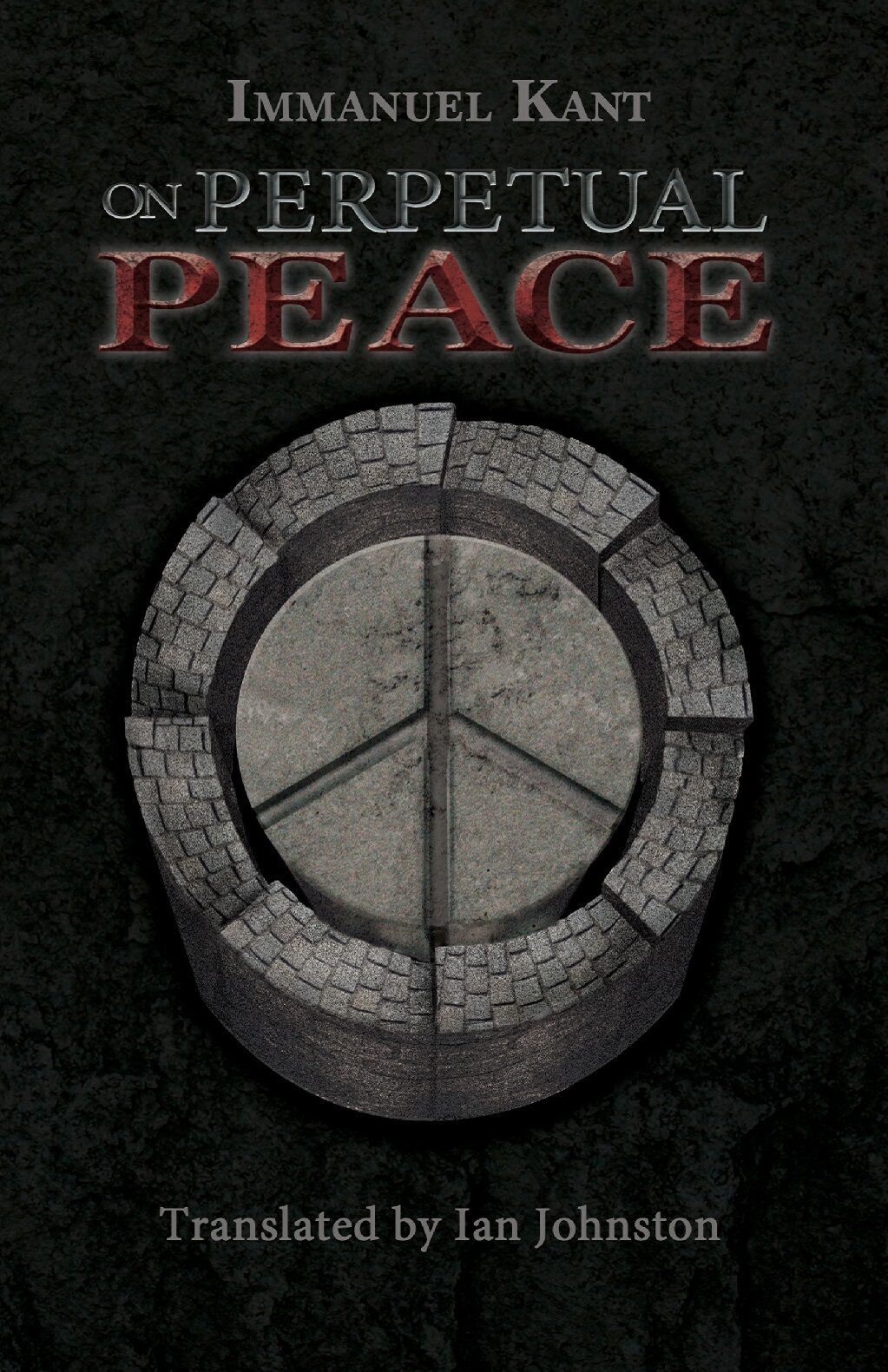
On Perpetual Peace

By Kant, Immanuel

$10.95

Secure checkout · Free US shipping on orders over $50

Immanuel Kant's On Perpetual Peace, published in 1795, is a landmark document exploring the ancient question of how human societies can create conditions which foster peace among nations. Kant concedes that such a state of peace is not a natural condition, but he offers the often tentative hope that if certain international principles are adopted a progress towards such a peace is certainly possible, at least among a federation of free states. The essay lays down specific principles and explores in some detail the eternal conflict between morality and political expediency, arguing that the two are not as diametrically opposed as many would maintain: "If it is our duty to realize a condition of public right and if, at the same time, there are grounds for hope we can achieve that, although only by an endless progress which takes us closer to it, then perpetual peace, which follows what have so far been falsely called peace treaties (which are really truces suspending hostilities) is not an empty idea, but a task which is gradually resolving itself and is always coming nearer to its goal (because the time it takes to make equal advances will, one hopes, grow shorter and shorter)."

This new translation by Ian Johnston is a fresh and faithful rendition of Kant's text. It also provides supplementary footnotes to assist the reader with contemporary references and potential ambiguities in the argument.
Category
Classics
ISBN (softcover)
978-1-935238-51-5
e-ISBN
978-1-935238-79-9
  • I have read your translation of Nietzsche\'s Toward a Genealogy of Morals and consider it to be far clearer than Kaufmann\'s.

    ______

    Your translation is wonderfully done. I wrote a paper on \"On the Use...\" in a graduate seminar and the copy from our library was stilted and awkward. Everything else I had read by Nietzsche was wonderfully fluid and poetic. I couldn\'t believe that the version from our library was by the same author. Your translation captures Nietzsche\'s poetic element wonderfully, bravo!

    ______

    I am enjoying very much your lucid translation of On the Genealogy of Morals. I find it much more accessible than the earlier Kaufmann edition, thus enabling a readier sense of conversation with this cantankerous uncle of ours. Thank you very much for having posted it online.

    ______


    I just wanted to say I think your translation of Zur Genealogie der Moral might be the best available on the Internet! It is not perfect, to be sure, but very, very good indeed.

    ______

    [re Kant]I haven\'t read through the entire translation yet, and much less compared it to the German (anyway, my German is rusty, and at least later on, Kant seems quite consciously forging a new technical vocabulary - \"Objekt\" vs. \"Gegenstand\" and all that...). What I did read through, leads me to think this is just dandy and a real contribution.

  • I have read your translation of Nietzsche\\\'s Toward a Genealogy of Morals and consider it to be far clearer than Kaufmann\\\'s.

    ______

    Your translation is wonderfully done. I wrote a paper on \\\"On the Use...\\\" in a graduate seminar and the copy from our library was stilted and awkward. Everything else I had read by Nietzsche was wonderfully fluid and poetic. I couldn\\\'t believe that the version from our library was by the same author. Your translation captures Nietzsche\\\'s poetic element wonderfully, bravo!

    ______

    I am enjoying very much your lucid translation of On the Genealogy of Morals. I find it much more accessible than the earlier Kaufmann edition, thus enabling a readier sense of conversation with this cantankerous uncle of ours. Thank you very much for having posted it online.

    ______


    I just wanted to say I think your translation of Zur Genealogie der Moral might be the best available on the Internet! It is not perfect, to be sure, but very, very good indeed.

    ______

    [re Kant]I haven\\\'t read through the entire translation yet, and much less compared it to the German (anyway, my German is rusty, and at least later on, Kant seems quite consciously forging a new technical vocabulary - \\\"Objekt\\\" vs. \\\"Gegenstand\\\" and all that...). What I did read through, leads me to think this is just dandy and a real contribution.

Also from Classics

You might also like

On Perpetual Peace

$10.95